
Professional Development Edition
Welcome to Grace’s Comics Ops Newsletter: Professional Development Edition

Welcome to Grace’s Comics Ops Newsletter: Professional Development Edition
These articles are meant to be primers on topics ranging from making a graphic novel to applying to grants to tabling at a festival. They are by no means all-encompassing and are entirely based on my own personal experience in the indie press scene since 2018. In that time, a lot has changed, but I’ve learned even more.
As of 2024, I received a traditional book deal with Andrews McMeel Universal which has afforded me even more opportunities for career growth. I’ve started doing university visits, ran a successful kickstarter, and tabled at over fifty festivals.
My goal in these quarterly-ish posts is to remove some of the mystery behind the making of comics—from the drawing desk to the business.
Without further ado, let’s talk about tabling at comics festivals!
When applying to shows initially consider two things:
Cost
Remember you aren’t just covering your printing and merch costs, but travel and incidentals as well. When starting out look for shows accessible to you, they will likely be smaller DIY zine fests, but the experience will be no less valuable. If you are ready to take the travel leap, use your community, stay with friends, carpool, and consider making a bulk print order with peers to get discounts with the manufacturer.
I recommend checking out George Rohac’s cost/benefit sheet as a helpful tool. He is a consultant and operations manager for several indie publishers.
Personal Aesthetic
Your style is unique to you. That’s a beautiful thing. Not all shows are for everyone. Punk zine fests are generally less inclined to accept anime style art. An anime expo might not be a good fit if your work is literary auto bio. Tabling is as much about finding a space for your work to thrive in financially as it is about aesthetics.
Types of Shows
The festival scene can be broken down into lots of cultures and sub-cultures. Most festivals fall under the umbrella of three different catagories:
Comics Festivals: Focused on comics and sequential media. Can include cosplay and other media, but generally graphic novels and cartoonists are the highlight.
Zine Fests: Focused on printed ephemera and zines, usually with a DIY activist mindset.
Arts fairs/Crafts fairs: Focused on a range of products – from ceramics to stationery. I’ve notoriously struggled here financially because most of my work falls into the comics or zine category. It hasn’t been until recently when I started making more stationery that I started doing Renegade Crafts Fair, which is currently the only crafts fair I do. I participate in Renegade because it has a whimsical aesthetic that matches my art style and it’s local to me in Brooklyn so my costs are low.
Under the broad umbrella of comics festivals are indie/small press festivals and ‘media’ or mainstream shows. For example, Small Press Expo in Bethesda, MD is very different to San Diego Comic Con. While both serve overlapping communities, there is significant different in attendance numbers and vibes. That said, both myself and plenty of other artists participate in both.
SDCC will have a larger breath of art and media available to attendees. Panels, events, meetups, and artist alley with cover everything from manga to superhero to graphic novel works. They are located in large convention centers with large crowds. There will be a lot of merch for sale. The table fees are also high. For example, an artist alley table (as of 2024) at New York City Comic Con is ~$565.00.
SPX and other indie press festivals will be smaller, with a focus on literary graphic novels, zines, and are generally more financially accessible. These shows are often located at a variety of venues; everything from churches, hotels, or universities. The attendance can range greatly. A table at MICE, one of the premier east coast indie festivals, is ~$175.00. Attendees at indie festivals are interested in buying books—especially at SPX.
Pricing Merch
For small press shows try to have at least 50-60 percent of your table be zines/mini comics/graphic novels as the goal of these shows is to highlight comics not merch. That said, it is important to have a range of products and price points.
To determine pricing, I use a x3 method. This means that I multiply the cost of the product by three. This ensures I am making at least some return. I also check in with other vendors to see what price points my work compares to.
Some other pricing tips
Keep numbers round. This helps with making change. I personally work in intervals of five.
Offer discounts for bundling products. My washi tape is $10, but I offer a 2 for $15 deal.
- Have a range of payment options. For those starting out, Venmo, CashApp, and Zelle are great options. For Canadians, E-Transfer is great.
For examples of the merch I sell you can check out my Etsy. E-Commerce is an entirely different beast, one that I have not at all tackled. If anyone has good recommendations for e-commerce platforms send them my way.
What to Bring
How much inventory do I bring?
When I was starting out tabling I never brought more than 20 of my smaller items and 10 of my mini-comics, zines, etc. As I’ve grown, I now bring things in 20’s. My big sellers, like my Cat RPG, I can sell 25 in a good weekend.
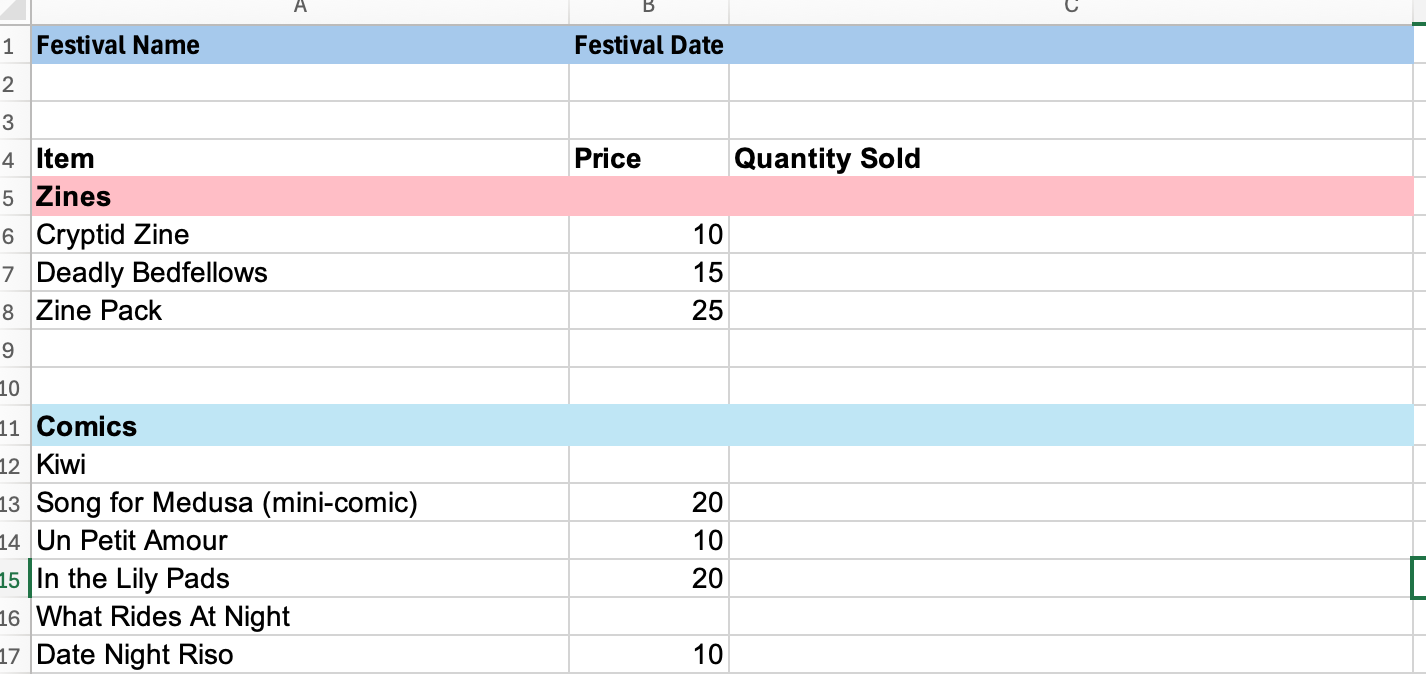
The way I determined what sells is by tracking it in a printed spreadsheet that I bring with me to every show. Counting inventory at the end of the festival to make sure it matches up with my tally. From there I determine what I want to re-print or re-order.
Here is what that inventory sheet looks like:
I recommend keeping a small stash of items to trade with fellow artists. It’s a great way to meet new people and share your work with prospective art directors or publishers.
The most important thing to pack is some kind of payment system. I personally use Stripe (can take international payments) for credit cards, Venmo, and of course cash is king.
My “register” always starts at $100.00, broken down into 1 $20.00, 2 $10.00’s, 4 $5.00’s, and 20 $1.00’s. This makes counting my total at the end of the day simple. Every festival ends and I make sure my register is balanced again at $100.00.
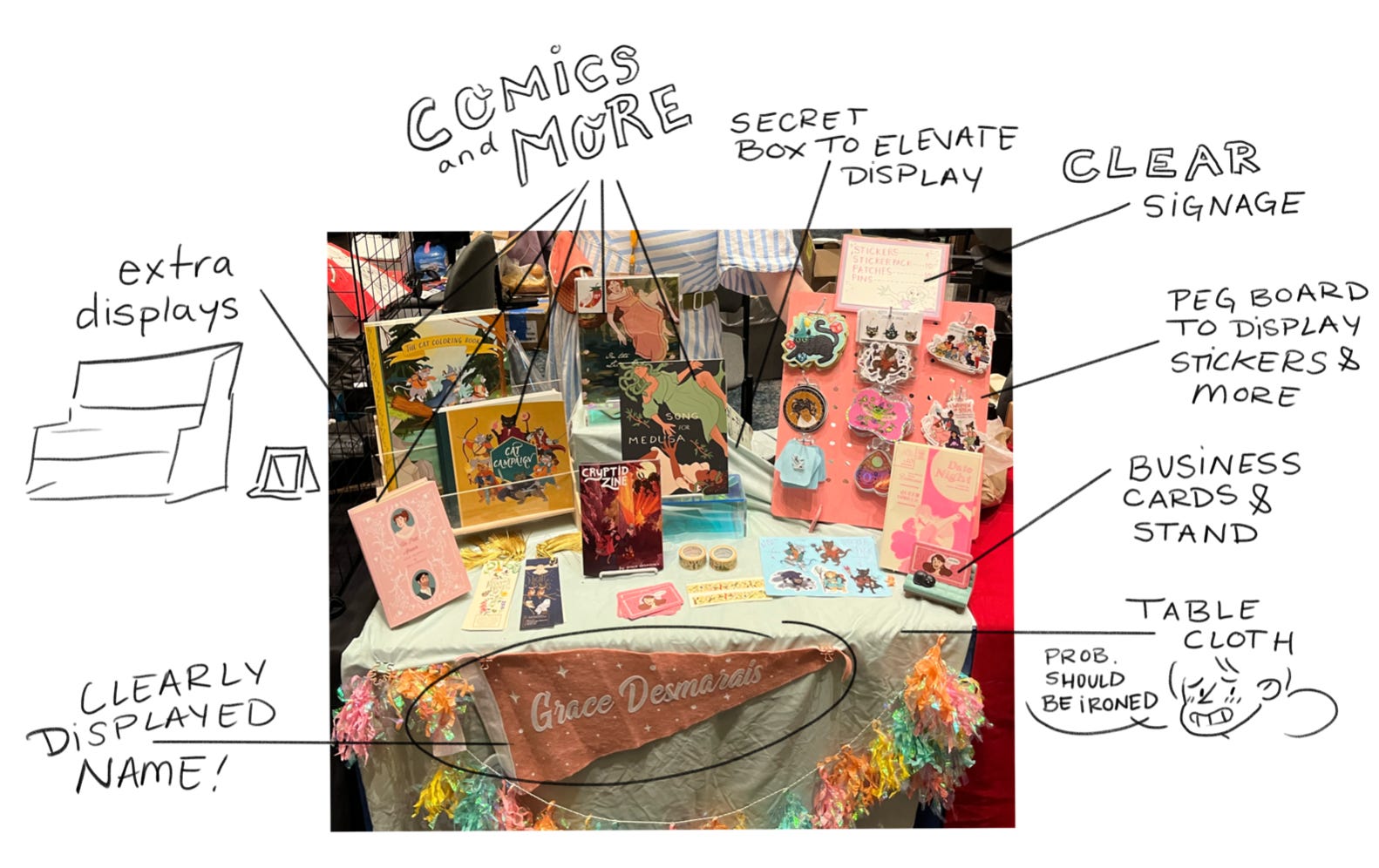
Having cut my teeth in years of retail, I’ve also learned having an aesthetically pleasing display is key in making sales. Verticality can help customers notice you better, so I recommend tiered displays. Personally, I use displays from ClearDisplays but don’t count out DIY! This website has great tutorials on how to make cool displays with cardboard.
Some other essentials to pack:
Refillable water bottle
Tablecloth, I use a thrifted bedsheet.
Business cards or some kind of giveaway with your contact on it.
Banner, this is a great way to grab attention and show off your crafty side.
Portable charger
Tape, scissors, pens, paper, and anything else for some emergency crafting.
Comfortable shoes, I switch into my adidas slides secretly behind the table. They are a lifesaver and flat to pack.
Premade price signs and/or price sheet
A mask/N95
A buddy, it’s a huge help to bring a friend when you are starting out to help relieve you for bathroom/mental health breaks. Most festivals also have fabulous volunteers that can help cover your table while you refill your water bottle or take five.
Grace’s Favorite Festivals
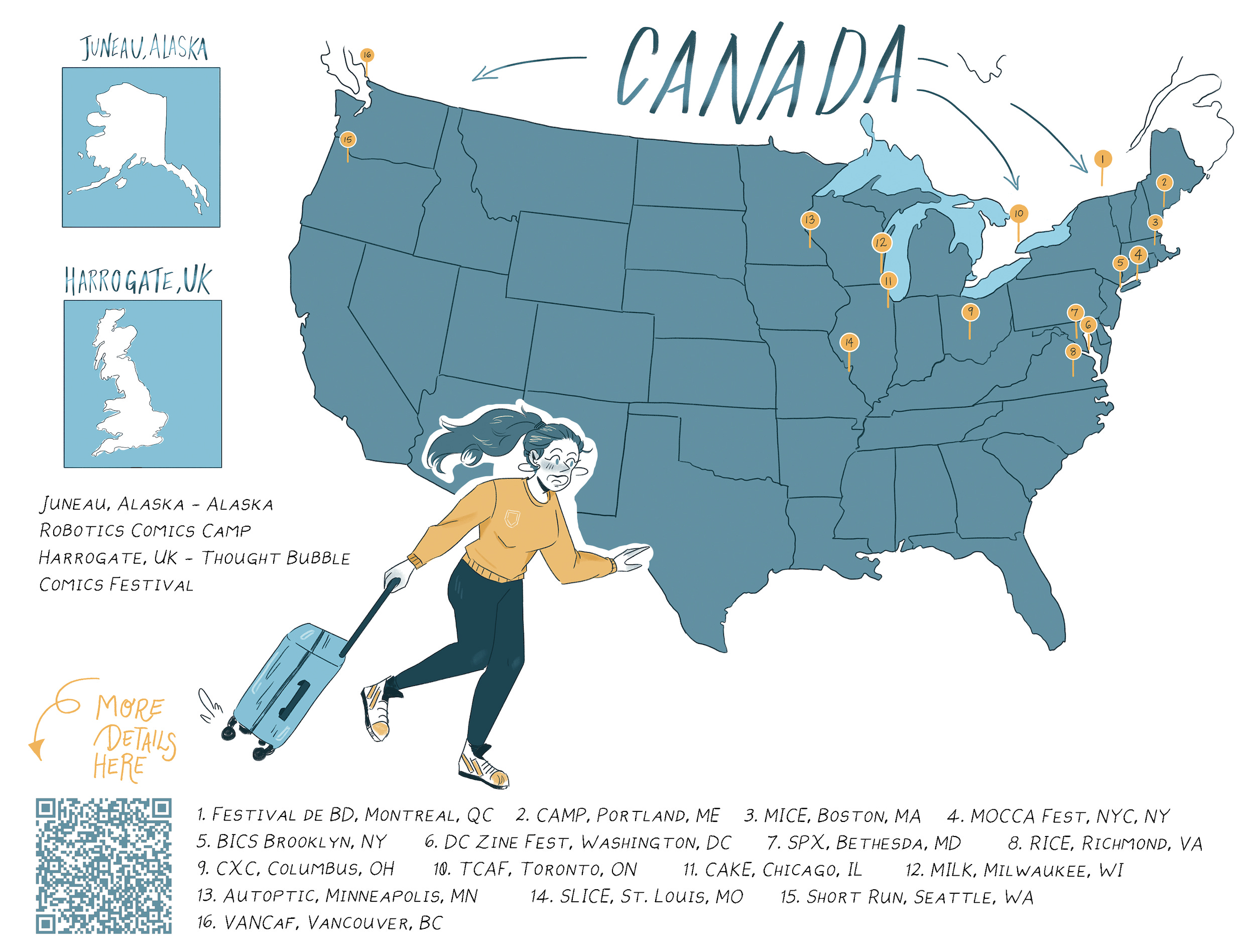
This list has been curated over eight years of tabling and attendee experience. These are shows that I’ve done the best at financially and socially. The places where I felt my work fit in best. It by no means reflects the broader, vibrant world of comics festivals nor does it mean that these fests should be the end of your personal research of opportunities.
This spread sheet is in the middle of being updated from 2022/23, but I still stand behind my picks.
Additional Resources
Kids Comics Unite has a fabulous article about tabling written by Bailey Culver featuring the fabulous Joe Latham. Joe does a great job addressing convention jitters which I did not have time to cover here.
Megan Raley’s Tabling 101 is an essential. It helped me starting out.
Sequential Artists Workshop has an awesome episode about tabling and making friends
Artists to Look at for Inspiration
Best of luck at your next festival!
Great addition to the regular resource/opportunity updates! Look forward to seeing more of these.